
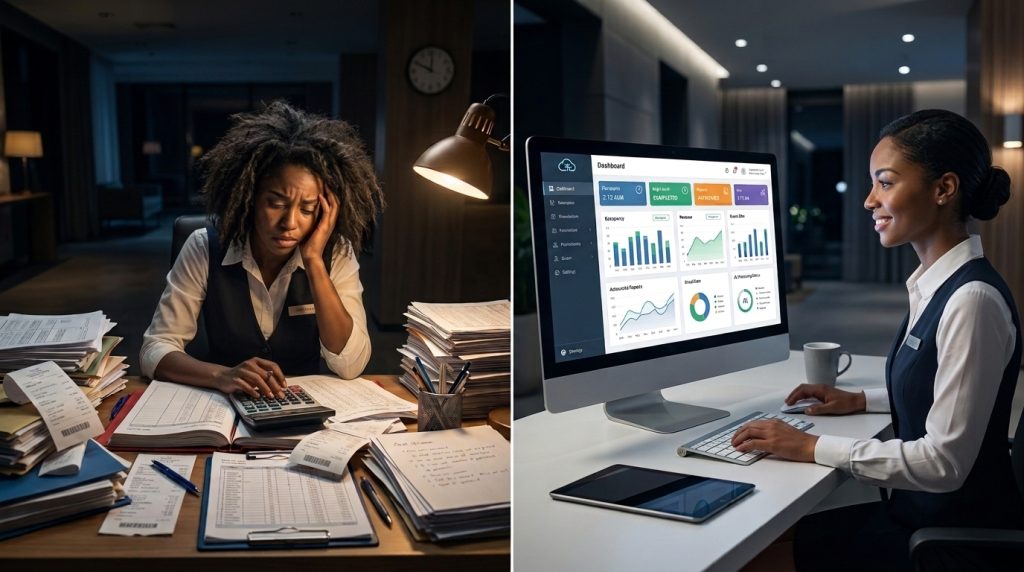
It’s past midnight, and while every guest at the hotel is asleep, one person is still wide awake at the hotel, sifting through the day’s paper folios, checking that every charge lines up, every payment was logged, every room status is right. By 3 am, she’s caught two mistakes: a room billed at the wrong rate, and a payment that never made it into the books. She fixes them by hand, closes out the day, and knows she’ll be doing the same thing again tomorrow night.
This is the night audit; the quiet, thankless job that keeps a hotel’s numbers honest, and one of the most draining tasks in the building when there’s no system doing the heavy lifting.
What a night audit actually is
A night audit is the process of closing out the hotel’s day reconciling every charge, payment, and room status before a new day officially begins in the system. It’s how a hotel makes sure the numbers it reports actually match what happened: the right rates were charged, no payment slipped through unrecorded, no room was left in the wrong status heading into tomorrow. It’s not just paperwork. It’s the checkpoint that keeps a hotel’s financial records honest, night after night.
Why it’s exhausting when it’s manual
Done by hand, a night audit means going through the day’s transactions one at a time, cross-checking folios against payments, correcting errors as they’re found, and preparing reports before the next day can start. It’s detailed, repetitive work done alone, usually late at night, when tired eyes are most likely to miss something.
And when something is missed, it doesn’t just disappear. It shows up later as a discrepancy nobody can explain, a guest disputing a charge, or a revenue report that quietly doesn’t add up.
Where the manual process breaks down
- Human error creeps in at the worst time: Night audits happen when people are most fatigued, which is exactly when small mistakes such as a missed charge, a wrong rate, or a skipped room status update are most likely to slip through unnoticed.
- It takes far longer than it should: Manually reconciling every transaction can take hours, especially in a busy property. That’s time a staff member could spend on something that actually needs a human, like handling a late-arriving guest instead of repetitive checking.
- Mistakes are hard to trace after the fact: If a discrepancy is found days later, tracing it back to the exact transaction, shift, or staff member involved becomes its own project, on top of fixing the actual error.
How software makes it automatic
A hotel management system built to handle night audits does the reconciliation work in the background, like matching charges to payments, flagging discrepancies immediately instead of hours or days later, and rolling the date forward automatically once everything checks out. It doesn’t eliminate the need for oversight, but it removes the hours of manual cross-checking, and it catches errors while they’re still easy to fix.
This is exactly the kind of task eZee’s system handles quietly, running the audit process automatically at the end of each day, checking room status, folios, and payments against each other, and surfacing anything that doesn’t match before the new day begins. What used to take hours of manual checking becomes a process that runs itself, with a clear report at the end instead of a stack of paper folios to sort through.
What this actually changes
It’s not just about saving time, though that matters too. It’s about a hotel’s numbers being something the team can actually trust closed correctly every night, without depending on one exhausted person catching every mistake at 3 am. Because a hotel shouldn’t need someone to stay up all night just to make sure the numbers add up in the morning.
Stop letting one exhausted person carry the weight of your hotel’s numbers every night. See how eZee solution automates your night audit. Book a demo today.