
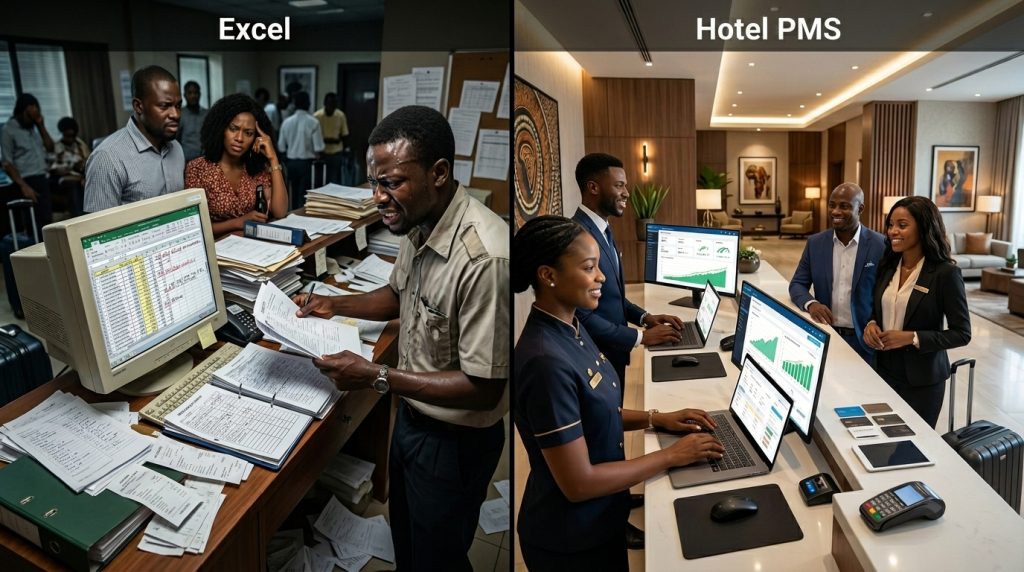
Many hotels in Nigeria still run important parts of their operations on Excel. Room bookings sit in one sheet, guest payments sit in another, while housekeeping updates come through calls or WhatsApp. The owner or manager then tries to make sense of everything at the end of the day. It feels manageable at first. Excel seems familiar and looks cheap. And for small hotels, it can seem like a practical way to stay organized. But that “cheap” system often becomes expensive very quickly.
The real debate between the hotel management system vs Excel is that Excel can store information, but it cannot run a hotel. Once bookings increase, walk-ins become frequent, and staff begin to work across shifts, spreadsheets start creating blind spots. And blind spots are where hotels lose money.
Where Excel Starts To Fail Hotels
Excel is usually good for static records. Hotels are not static.
A hotel changes by the minute. A guest could check out early, while another guest wants to extend. A walk-in arrives at 9:30 p.m. Housekeeping finishes one room but is still cleaning two more. The bar posts a charge late. A transfer payment reflects after some delay. If all of that is being tracked manually, errors are almost guaranteed.
What usually happens is not one big disaster. It is many small losses. Look at this;
- A room gets double-booked because two staff members updated different sheets.
- A guest checks out with one restaurant charge missing from the final bill.
- The front desk sells a room at the wrong rate because the Excel file was not updated after demand increased.
- A manager cannot tell which bookings came from direct channels and which came from OTAs like Booking.com or Hotels.ng.
- Staff actions are hard to trace, so billing mistakes and quiet revenue leaks go unnoticed.
Each one may look small, but together, they eat into profit.
The hidden cost of “free”
This is where many hotel owners get trapped. Excel feels free, so it looks like the cheaper option. But the money lost through delays, missed charges, weak reporting, and poor coordination is often far more than the cost of proper software.
For example.
If a 25-room hotel in Lagos misses:
- two room charges in a week at ₦55,000 each,
- three unposted food or drink bills at ₦12,000 each,
- and one weekend pricing opportunity during a high-demand period, that hotel could lose well over ₦200,000 without even noticing immediately.
These are some hidden prices to pay for working with spreadsheets.
What a hotel PMS does that Excel cannot
A proper hotel PMS is built for live operations, not static tracking.
It helps hotels manage reservations, check-ins, check-outs, room status, billing, reporting, and guest history in one system. Instead of staff passing information around manually, everyone works from the same updated view.
That means:
- front desk can see which rooms are ready in real time,
- housekeeping updates are visible without extra calls,
- guest charges post more accurately,
- direct bookings and OTA bookings are easier to track,
- reports are cleaner and faster,
- and management gets better visibility into what is actually happening.
In short, a PMS reduces the small daily mistakes that quietly cost hotels money.
“But Our Internet Is Not Always Stable”
That concern is real, especially for many hotels outside the most stable business districts.
This is one reason hotels should not just look for any software, but for one that fits local realities. A practical system should support how Nigerian hotels actually operate, including days when connectivity is not perfect, payments come in different forms, and teams need something simple enough to use under pressure.
That is also why implementation matters, not just the software itself.
Why More Hotels Are Replacing Excel
Hotels usually do not move away from Excel because they suddenly love technology. They move because the old method starts costing too much.
They want:
- fewer billing mistakes,
- faster check-in,
- better room control,
- clearer reports,
- stronger accountability,
- and less dependence on manual updates.
That is where systems like eZee Absolute and eZee Optimus, deployed by AOG Consulting, start to make sense. They help hotels replace scattered spreadsheets with one clearer operational flow. Not in an overly dramatic way, just in a practical way that saves time, reduces stress, and protects revenue.
This is not to say Excel is evil. It is just not a hotel management system. Although it can help you record numbers, it cannot help you run a busy hotel properly. And in a fast-moving market like Nigeria, that gap can cost real money. So if your team is still managing bookings, room status, guest bills, and daily reporting across spreadsheets, the bigger question is no longer whether Excel works. The real question is: how much is it already costing you?
A proper PMS will not solve every hotel problem overnight. But it will give your team a better system, stronger visibility, and fewer chances for money to leak through the cracks. You can check how it works with AOG Consulting. A practical next step is to explore a system that fits your hotel size, workflow, and budget – without the confusion of running everything from Excel.