
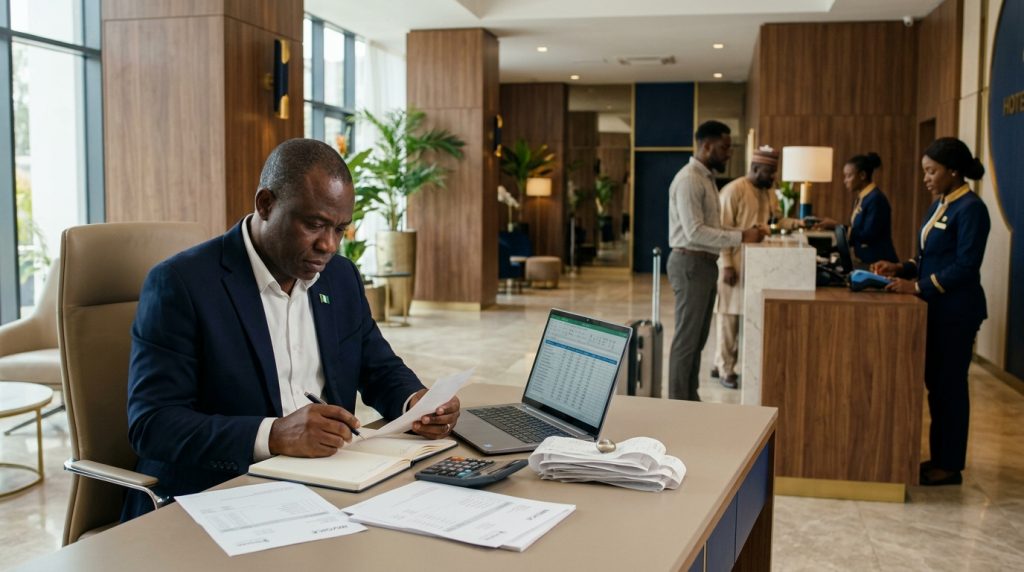
Revenue leakage doesn’t look like theft, and it doesn’t feel like a crisis. It looks like a minibar charge nobody billed, a no-show fee quietly waived at the desk because arguing felt like too much effort that day, a commission invoice from an OTA that nobody double-checked against the actual contract. One by one, these feel too small to chase. Added up over a year, they’re the quiet reason a hotel’s books never quite match what the business should have earned.
And the scale here is bigger than most owners assume. A global survey of 2,000 hotel revenue managers found that 98% of hoteliers lose an average of 6% of revenue annually to rate leakage alone, with more than half experiencing it weekly or more often. Across the broader hospitality industry, typical leakage sits between 3% and 12% of total revenue which on a $4 million property works out to somewhere between $120,000 and $480,000 a year, essentially vanishing without ever showing up as one clear, traceable loss.
Here are five practical ways to actually find it and stop it.
1. Audit your OTA commissions and virtual cards line by line
OTAs are a major, necessary source of bookings, but they’re also one of the biggest leakage sources hiding in plain sight. Commission invoices sometimes differ from the terms a hotel actually agreed to, and on prepaid bookings paid via virtual credit card, errors in the activation date, balance, or expiration window quietly cost hotels money that’s rarely chased down. Hotels lose between 1% and 2% of OTA revenue every month purely from these kinds of undetected inconsistencies, a gap most hotels never think to reconcile manually, simply because it’s tedious and easy to assume is fine.
What to do: Set a regular schedule, monthly at minimum, to cross-check OTA commission invoices against your actual contracted rates, and verify virtual card balances before they expire unused.
2. Watch your no-show and cancellation fees closely
If your policy entitles you to a fee, and that fee never gets charged, that’s leakage too, and it happens more often than most front desk teams realize. Common causes include fees waived at the desk without real justification, cards on file that decline and are never retried, and OTA no-shows that simply never get marked correctly in the system.
What to do: Build a simple, non-negotiable process for marking no-shows and retrying declined cards, and require a logged reason any time a fee is waived; visibility alone tends to reduce how often it happens casually.
3. Track unbilled F&B and service charges
A minibar restock that never makes it to the bill. A room service charge that gets forgotten in a busy shift. Food and beverage operations are a major, recurring source of unbilled service leakage because they rely on someone to manually post a charge before a guest checks out.
What to do: Reduce how much relies on memory. A connected POS that posts charges to the guest folio automatically, the moment a transaction happens, closes most of this gap without needing anyone to double-check it later.
4. Fix pricing inconsistencies across channels
Even hotels that invest heavily in revenue management tools and competitor pricing analysis still lose real revenue to inconsistent rate application and poorly executed dynamic pricing across their different booking channels. More than half of hoteliers manage four to six distribution partners at once, which makes rate consistency genuinely hard to control without the right system; a price update made on one channel but missed on another is leakage hiding behind a spreadsheet nobody has time to fully check.
What to do: 99% of hoteliers surveyed agree that a centralized distribution platform helps reduce this kind of leakage and protect revenue , a single system pushing rate changes everywhere at once removes the manual gap where inconsistency creeps in.
5. Get real oversight, not just a monthly glance
Hotels and restaurants without centralized revenue tracking often fail to catch leakage points in time, simply because nobody has a single, reliable view across every service area where money moves. By the time a monthly report flags something odd, weeks of small losses have usually already compounded.
What to do: AI-based monitoring is increasingly treated as a genuine financial investment rather than just an accounting tool, because catching a billing error or a missed charge the day it happens is a very different outcome from discovering it three months later, buried in a reconciliation nobody wanted to do.
Why this deserves real attention, not just a shrug
It’s tempting to treat each of these as too small to matter individually, and that’s exactly the trap. A single missing charge, an unapproved discount, or one reconciliation error can look trivial on its own. Still, the cumulative impact across hundreds or thousands of transactions is what actually erodes profitability. A $10 million hotel losing just 2% to leakage is quietly giving up $200,000 a year , money that was already earned, just never collected.
How this plays out for your hotel
Real-time PMS and POS integration means charges post instantly, with no manual step where something can get forgotten. Centralized channel management keeps rates consistent across every platform from one dashboard, instead of five separate logins nobody has time to cross-check. And unified reporting gives management one honest view of where money is actually going, instead of discovering a gap months after it’s already added up.
The question worth asking
If someone asked you right now what percentage of your hotel’s revenue quietly leaked out last month, could you actually answer? For most properties still relying on manual checks and separate systems, the honest answer is no, and that uncertainty is exactly where the money keeps disappearing.
Ready to find out where yours is happening?
If you’re not sure how much revenue leakage your hotel is dealing with, that’s worth finding out before it adds up further. Reach out to us; let’s see how we can help you spot it and stop it with one connected system.