Few things hold back hospitality growth in Nigeria as quietly as one phrase: “We’ve always done it this way.”
Change, they say, is the only constant. The world is evolving, and hotels need to evolve with it. But let’s be honest: “we’ve always done it this way” is not laziness. Most of the time, it comes from a genuine place: the comfort of knowing a system, trusting what has worked before, and not wanting to risk disrupting an operation that is, at least on the surface, still running. But here is the problem: the world your hotel was built for no longer exists.
Three Conversations Happening in Nigerian Hotels Every Day
Picture this. A hotel owner in Lagos is told by a consultant that his manual booking register is costing him reservations. His response? “We’ve been doing it this way for twelve years, and it has worked fine.”
A general manager in Abuja is shown data proving that her flat room rates are causing the hotel to lose money during peak periods. Her response? “That’s just how we price here.”
A front office manager in Port Harcourt is asked why guest complaints are not being documented. His response? “We handle everything verbally. It’s always worked for us.”
These are not isolated conversations. They happen every day across Nigerian hotels, and they share one thing in common: a quiet, stubborn resistance to change that is costing hospitality growth in Nigeria more than anyone wants to admit.
The Guest Has Changed. Has Your Hotel?
The Nigerian traveller of today is not the same person who walked through your doors ten years ago. They have travelled internationally. They compare your hotel to properties they’ve seen on Instagram. They book on their phones at midnight. They leave reviews within hours of checking out. They expect Wi-Fi that works, fast check-ins, and responses to their messages in minutes, not days.
When your operation is still built around the assumptions of 2010, you are not serving today’s guest. You are serving a guest who no longer exists.
What Resistance to Change Is Actually Costing You
The damage this mindset does to hospitality growth in Nigeria is rarely dramatic. It doesn’t announce itself. It accumulates quietly, in ways that are easy to miss until the numbers become impossible to ignore. Here is what resistance to change is actually causing you:
- Lost bookings: You are losing bookings to hotels that are visible on Booking.com, Expedia and Google, while yours still relies on phone calls and walk-ins. (A channel manager fixes this.)
- Lost revenue: You are leaving money behind because your room rates don’t change with demand, seasons or competitor pricing. (See our guide to peak season pricing.)
- Lost staff: You are losing good people because talented, ambitious hospitality professionals don’t want to work where growth, innovation and new ideas are quietly discouraged, or where training is left to chance.
- Lost repeat guests: You are losing returning guests because inconsistent service, rooted in the absence of proper systems and training, makes them unsure what experience they’ll get next time.
None of this happens overnight. But it compounds. By the time most hotel owners notice the trend, they are already significantly behind. The real enemy of hospitality growth in Nigeria is not change; it is invisible decline.
Not sure which of these is costing your hotel the most? Book a consultation and get an honest outside view of where your property stands. Book a consultation →
The Uncomfortable Truth About Hospitality Growth in Nigeria
Here is the uncomfortable truth: hotels that refuse to evolve don’t collapse suddenly. They decline slowly, gradually and almost invisibly, until one day the occupancy numbers tell a story that can no longer be explained away.
The good news is that changing this mindset does not require a complete overhaul overnight. It starts with one honest question: “Is this process serving our guests and our business, or is it just familiar?”
If the only defence of a process is that it has always existed, that is not a defence at all. That is a warning sign.
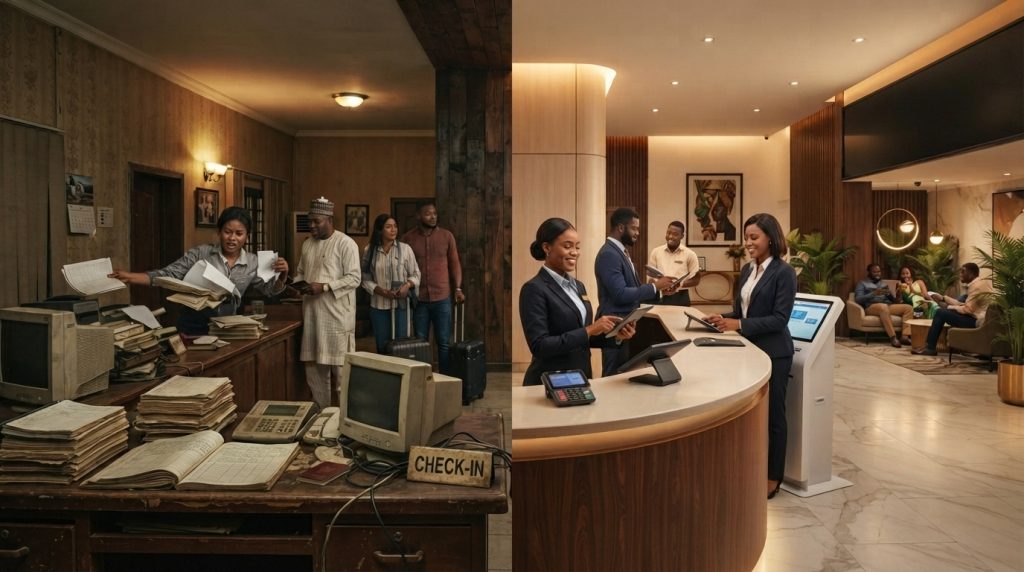
4 Small Changes That Get Things Moving
Good change management, the kind that drives real hospitality growth in Nigeria, doesn’t start with a big launch. Try these small steps and watch how much progress they make:
- Start with small, visible wins. Pick one process, like digital check-in or a shared booking calendar, fix it, and let the team see the difference.
- Involve your team in the process. Staff who help shape a change are far more likely to stick with it than staff who have it handed to them.
- Measure everything. Track occupancy, revenue and guest feedback before and after each change, so results speak louder than habits.
- Find a mentor or consultant who has done it before. An outside view spots the blind spots you’ve stopped noticing and shortens the learning curve.
Want an experienced guide for that last step? Our consultants support hospitality growth in Nigeria by helping hotels modernise one practical step at a time. Book a consultation →
In Conclusion
“We’ve always done it this way” is not a strategy. It is a comfort blanket, and in a rapidly evolving market, it is quietly suffocating hospitality growth in Nigeria.
Change can feel overwhelming, especially when your hotel has operated a certain way for years. But you don’t have to figure it out alone. At Apples of Gold Consulting, we help Nigerian hospitality businesses modernise their operations, improve guest satisfaction and grow revenue without losing the soul of what makes them great. Send us a DM now, and let’s have a conversation.