A new front desk hire in a reputable hotel once spent her first two weeks shadowing a senior colleague, scribbling notes in a jotter, hoping she’d remember it all by the time she was on her own. By week three, she was on the floor solo, confident about some things, quietly guessing about others. Nobody caught the gaps until a guest pointed one out.This is the exact problem hotel staff training software is designed to prevent.
She wasn’t incapable. She’d been trained the way a lot of hospitality staff still are, which is watching someone else, for however long there was time, and hoping enough of it stuck. That’s not really training, and that’s hoping for the best and calling it onboarding.Hotel staff training software exists specifically to close this gap, delivering the same material, every time, to every hire.
Why the old way of training keeps falling short
Hotels lose staff more often than most industries can comfortably plan around. Hospitality consistently sees some of the highest turnover rates across all sectors, which means there’s almost always someone new to train, and rarely enough time to do it properly. Add irregular shifts, busy seasons, and a front desk that can’t afford to be short-staffed for a “training day,” and it’s easy to see why onboarding so often gets squeezed into whatever time is left over. The result is training that depends heavily on luck. One new hire happens to shadow a patient, thorough colleague and comes out well-prepared. Another gets rushed through the basics on a chaotic Friday night shift and is left to fill in the blanks on their own. Neither of them chose that. It’s simply what happens when training rides on whoever’s available that day, instead of something every hire goes through the same way.
What Hotel Staff Training Software Actually Changes
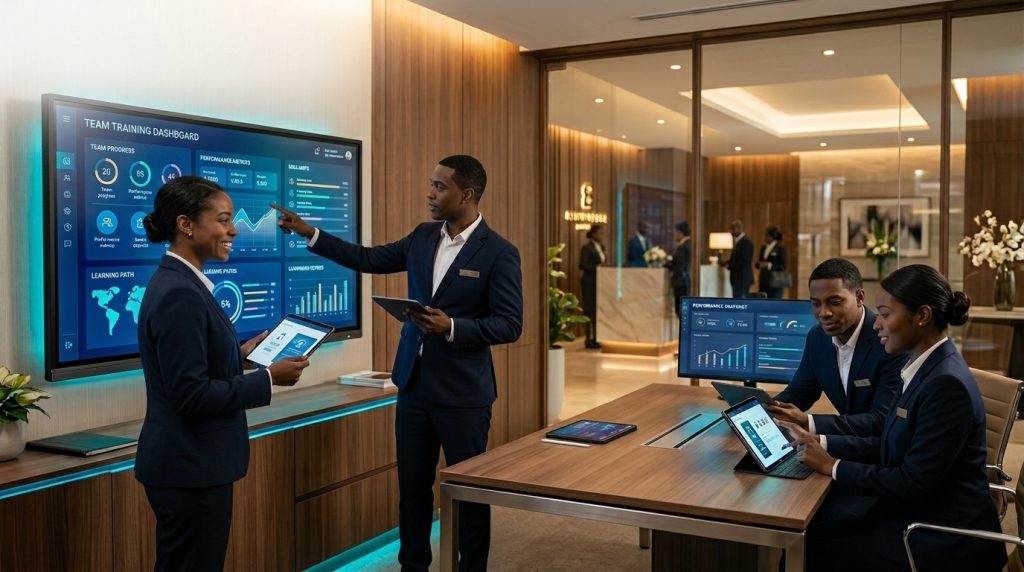
Hotel staff training software doesn’t take the human touch out of onboarding; it only takes the guesswork out.; it only takes the guesswork out. Structured training lets new hires move through role-specific material at their own pace, so a housekeeper isn’t sitting through the same generic session as a front desk agent, half of it irrelevant to the job they actually do. Here are a few benefits that comes where training becomes automated;
Every hire gets the same solid foundation: Whether someone joins in January or June, automated training means they go through the same core material, covering the same standards, without depending on which colleague happened to be on shift during their first week.
Training doesn’t get abandoned halfway: Short, mobile-friendly training modules see completion rates well above 90%, compared to under 5% for traditional, lengthy training sessions, mostly because staff can work through a five-minute lesson between tasks, instead of needing a rare, uninterrupted hour that seldom shows up in a hotel schedule.
A clearer picture for management: Instead of guessing who’s up to speed and who isn’t, managers can actually see who’s completed what, who’s overdue for a refresher, and where the real skill gaps are before those gaps show up in a guest complaint. New hires trained on a structured, repeatable system tend to find their footing faster, simply because the material is consistent and always there to revisit, not locked away in one person’s memory, only accessible if that person happens to be around.
Why this matters most in the day-to-day
Efficient staff isn’t just fast. They’re staff who know what’s expected of them without needing to pull a busy colleague aside mid-shift to ask. Automated training closes that gap early, so new hires spend their first weeks actually serving guests confidently, instead of quietly piecing things together as they go. It also protects consistency as a hotel grows. A property with multiple outlets, or a group with several locations, can roll the same standards out everywhere at once, instead of service quality drifting from one property to the next, depending on who happened to be doing the training locally.
What this looks like in practice
This is exactly the gap Apples of Gold Consulting works to close for hotels across Nigeria, building structured, role-specific training that doesn’t hinge on one manager’s schedule, patience, or memory to deliver consistently. By pairing hands-on facilitation with hotel staff training software, AOG helps hotels bring new staff up to speed faster, AOG helps hotels bring new staff up to speed faster, keep service standards consistent shift after shift, and give management real visibility into where extra coaching is actually needed instead of finding out the hard way, after a guest has already noticed.
Automated hospitality training was never really about replacing people. It’s about making sure the effort that does go into training isn’t wasted repeating the same information inconsistently, hire after hire, shift after shift. When training is structured and repeatable, staff spend less time guessing their way through the job and more time doing the parts of it they were actually hired for.
That’s the real return. Not just a faster onboarding process, but a team that walks onto the floor ready, from day one, every time.
Ready to implement hotel staff training software your team actually completes? Reach out to Apples of Gold Consulting Limited to get started.