
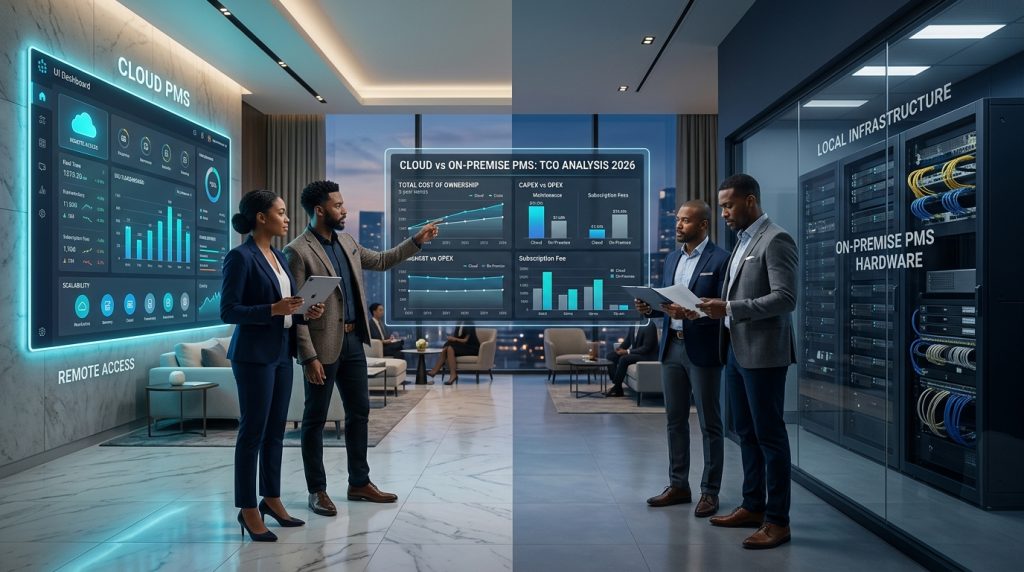
Cloud PMS is the system a hotel owner swore she would avoid when she bought her old PMS outright, years ago; she said that just to skip “wasting money on subscriptions.” On paper, it sounded like the frugal choice. In practice, she was still paying for a property management system but just less visibly: a server that needed replacing every few years, an IT contractor on standby for every glitch, and annual maintenance fees that quietly added up to more than a subscription ever would have.
In a real sense, she didn’t avoid the cost. She just spread it out in places that were harder to see.
This is exactly why comparing this cloud-based approach to an on-premises PMS by sticker price alone tells you almost nothing. The real comparison only makes sense once you look at total cost of ownership, everything a hotel actually pays over the life of the system, not just what’s on the invoice in year one.
What total cost of ownership actually includes
Total cost of ownership is the full, all-in figure once every line item is on the table, such as subscription or license fees, implementation and setup, training, integrations, payment processing, support, and any add-on modules bolted on later. Most PMS comparisons stop at the number a vendor leads with, which is exactly where budgets quietly break later.
On-premise PMS: the upfront number is only the start
An on-premise PMS runs on hardware physically sitting inside the hotel. Initial setup typically starts around a specific amount and can sometimes exceed the budget for larger installations, with annual maintenance adding another fee on top. That’s before the IT staff or contractor needed to keep it running, and the hardware refresh every few years most owners don’t budget for until it’s suddenly due.
Across five years, a 50-room hotel running an on-premise system typically pays for the total once licenses, hardware, and maintenance are counted, A number that rarely comes up in a single conversation with the vendor because it accumulates gradually, year after year.
However with Cloud PMS, the ongoing cost is more honest, if less flattering upfront
A Cloud PMS runs on the vendor’s servers and is accessed through the internet, with the hotel paying a recurring subscription that typically covers hosting, updates, and support. Entry-level platforms in this category often price around a certain amount per room per month, with enterprise-grade systems running higher depending on integrations and modules.
Over the same five-year period, a comparable subscription-based system for a 50-room hotel typically total sum of amount including hosting, support, and automatic updates, notably lower than the on-premises equivalent, and without the surprise hardware or IT costs showing up mid-cycle.
Where the real difference shows up
- No hardware, no hardware refresh: Going cloud-based removes the server room entirely, along with the four-to-five-year hardware replacement cycle that quietly resets the on-premises cost clock every time it comes around.
- No dedicated IT team required: On-premises systems typically need in-house IT staff or a paid contractor to manage updates, troubleshoot failures, and keep the server running. A subscription-based system shifts that responsibility to the vendor often invisible in a sticker-price comparison, but very visible in a hotel’s actual staffing budget.
- Automatic updates versus manual upgrade cycles: This kind of system updates itself in the background. An on-premises setup usually requires a manual upgrade process, which costs time, sometimes downtime, and occasionally a fee.
- Uptime becomes the real due diligence question: Going cloud shifts a hotel’s dependency toward internet connectivity and vendor uptime, which is why an uptime service-level agreement becomes a genuine line item to check before signing; the trade-off for lower cost is trusting the vendor’s infrastructure instead of your own.
Why Cloud PMS tends to win on total cost of ownership in 2026
For hotels under 100 rooms, this deployment model is now the practical default, with on-premises generally making sense only at enterprise scale where IT infrastructure already exists and strict local data control is required. For most independent and mid-sized properties, which describes the majority of Nigeria’s hotel market, the ongoing burden of hardware, IT staffing, and maintenance rarely pays for itself the way an outright purchase seems to promise on day one.
What this looks like in practice
This is exactly the trade-off eZee’s Cloud PMS, eZee Absolute, is built around. Because it runs entirely online, there’s no server room to maintain, no hardware refresh cycle to budget for, and no in-house IT team required to keep it running; updates, hosting, and support all come built into the subscription. For a Nigerian hotel weighing the true cost of ownership rather than just the number on a quote, that structure removes most of the hidden costs that quietly inflate an on-premise system’s price over time.
The real comparison isn’t cloud versus on-premise. It’s honest versus hidden.
An on-premise PMS can look cheaper in the first conversation, and a subscription-based cloud system can look like “just another expense.” Total cost of ownership is what cuts through both impressions, and for most hotels in 2026, it points clearly toward Cloud PMS, not because on-premise is a bad system, but because its real costs simply take longer to show up on the bill.
Are you curious to see what a real cost comparison would look like for your hotel specifically? Get in touch with Apples of Gold Consulting Limited, and we’ll run the numbers with you.