
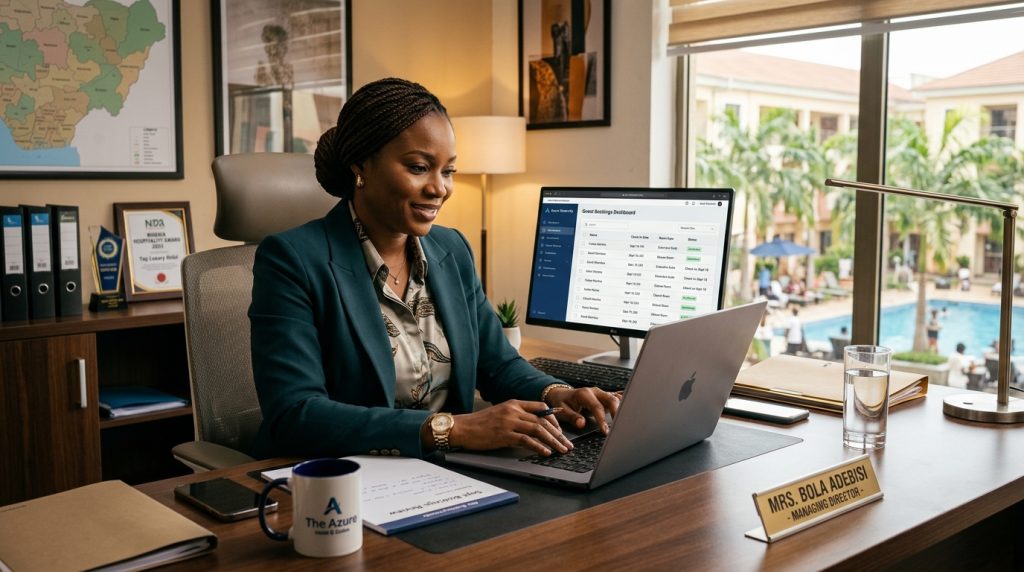
Hotel software is the difference between a website that just looks good and one that actually books guests.
A boutique hotel owner once told me her entire “booking system” was a WhatsApp number sitting in her Instagram bio, because she’d never gotten around to setting up real hotel software. It worked, more or less, until the day it didn’t. Messages piled up and got lost. Two guests booked the same room without either of them knowing. Worst of all, she once found out about a confirmed reservation three days after that guest had already checked into a different hotel altogether.
She wasn’t losing business because people didn’t want to stay with her. She was losing it because there was no hotel software behind her website to book guests directly. That’s still where a lot of Nigerian hotels are stuck — leaning on OTAs, phone calls, and Instagram DMs, while a perfectly good website sits there looking pretty and doing almost none of the actual selling.
A Nice-Looking Website Isn’t the Same as a Working One
Without proper hotel software behind it, a hotel website is really just a digital brochure. Guests can browse your rooms, admire the photos, read every last detail — and then have to leave your site entirely to book, usually landing on an OTA that takes a cut of a booking you worked hard to earn. Every guest who clicks away to book elsewhere is someone you already paid to attract, and now you’re sharing the reward with a third party. A properly built hotel booking engine closes that gap. It’s what turns your website from a shopfront into an actual point of sale.
What You Need Before You Set Anything Up
- Hotel software that actually connects to your website. This is the engine that lets guests pick dates, see real-time availability, and pay without ever leaving your site. It has to plug directly into your property management system (PMS) so a booking made online updates your room inventory everywhere, instantly.
- A payment option Nigerian guests will actually use. Local cards, bank transfers, and increasingly mobile payments. If paying feels like a hassle, guests will bail and go book on the OTA that makes it easier.
- A site that works properly on mobile. Most hotel bookings in Nigeria now start — and finish — on a phone. If your booking flow isn’t smooth on mobile, you’re losing guests before they even get to the payment screen.
- Real-time sync across every channel. The moment a room books on your website, it needs to vanish from every OTA listing too. Otherwise you’ve just swapped one double-booking headache for another.
Setting It Up, Step by Step
- Pick hotel software that integrates with your PMS. Not a basic contact form pretending to be a booking system — you want something guests can actually complete a reservation on, not one more inquiry you have to chase up manually.
- Add it to your website. Either embed the booking flow directly into your pages, or use a clearly visible “Book Now” button. Keep it on every page — don’t bury it in a dropdown menu somewhere.
- Load in your rates and room types. Whatever’s showing online needs to match what’s actually available and priced correctly, with no manual double-checking once it’s live.
- Turn on the payment methods your guests actually use, so nothing gets in the way of them finishing the booking.
- Walk through the whole guest journey yourself. Search dates, choose a room, pay, and confirm that the booking and room-blocking happen instantly, exactly as they should.
What This Looks Like With the Right Tools
This is precisely the problem hotel software like eZee is built to solve. It connects straight into your website, so guests can check availability, compare rates, and pay — all without leaving your site for an OTA.
Because it runs on the same back end as your PMS and channel manager, any hotel software worth using will update availability across every other channel automatically the moment a booking is made on your website. No double bookings, no manual syncing, no guesswork.
It even includes a rate comparison widget that shows guests your direct price next to OTA prices — a small but effective feature that shows just how much good hotel software can influence a guest’s decision to book with you instead of paying extra somewhere else.
eZee itself operates under Yanolja Cloud Solution, a global hospitality technology provider with a large customer base across many countries, which is part of why hotels trust its hotel software to handle something as critical as their booking flow. For a Nigerian hotel trying to cut down on OTA commissions, switching to the right hotel software isn’t a minor upgrade. It’s the difference between a website that just shows off your rooms and one that actually fills them.
Why This Matters Even More Going Into 2026
Nigerian travellers are increasingly comfortable booking and paying online, and they compare prices across platforms before deciding where to stay. A hotel without direct online booking isn’t just missing a convenience, it’s quietly pushing every guest who visits its website straight into an OTA’s hands, commission and all.
Fixing this isn’t complicated. It just takes the right hotel software, set up once, working quietly in the background from then on.
If your website is sending guests straight to an OTA, it’s costing you more than you think. The easiest way to see what a difference it makes is to see it in action. Book a free demo with AOG and we’ll walk you through the eZee software interface, show you exactly how the booking engine talks to your PMS and channel manager in real time, and answer any questions specific to your property. No pressure, just a clear look at how it works before you decide anything.