
A front office manager once spent an entire afternoon trying to figure out who checked a guest into a room that was supposed to be blocked for maintenance. Three people had access to the system that day. Nobody remembered doing it. The logbook just said “checked in” — no name, no time, no way to trace it back.
It wasn’t really about blame. It was about the fact that, without a clear record, there was no way to know what had actually gone wrong, or to teach the team how to avoid it next time. That’s the problem with managing hotel staff on memory, trust, and paper logs alone. Good intentions aren’t enough when there’s no record to back them up — and this is exactly the gap the right hotel software is built to close.
Why Accountability Breaks Down Without the Right Systems
Most hotels don’t have a staff problem. They have a visibility problem. Shifts change, tasks get handed off verbally, and by the time something goes wrong — a missed housekeeping check, a rate entered incorrectly, a guest complaint nobody followed up on — it’s nearly impossible to trace who did what, and when.
This isn’t a discipline issue. It’s a structural one. Without hotel software tracking actions, staff aren’t being held to a standard so much as being trusted to remember one, under pressure, during a busy shift. That’s an unfair position to put anyone in. It also puts managers in an impossible spot. When something goes wrong and there’s no record, a manager is left choosing between two bad options: let it go and hope it doesn’t happen again, or start questioning staff without any real evidence. Neither builds trust. Neither fixes the actual problem.
Common Signs Your Hotel Is Running on Guesswork
A few patterns tend to show up in properties that haven’t yet closed this gap:
- Shift handovers happen verbally, or through a WhatsApp message that gets buried within minutes.
- Multiple staff members share one login on the front desk terminal, so there’s no way to tell who did what.
- Housekeeping status updates rely on someone physically walking down the hallway to check, rather than a system update.
- Rate changes or discounts get applied without anyone being able to say who approved them.
- Guest complaints about room readiness or billing errors take days to trace back to a root cause, if they ever get traced at all.
If even two or three of these sound familiar, it’s less a staffing issue and more a hotel software gap.
Where Technology and Accountability Meet
This is exactly where technology and accountability start to work together, instead of against each other. A system that logs every action — who checked a guest in, who updated a rate, who marked a room as cleaned — doesn’t exist to catch people out. It exists to make the invisible parts of daily operations visible, so problems can be traced, fixed, and prevented, instead of argued over.
Here are three areas where the right hotel software can help improve accountability:
- Every action has a name attached. When a staff member logs in individually rather than sharing one terminal, every booking, rate change, or status update carries a clear record of who made it. That alone changes behaviour — not out of fear, but because people naturally take more care with work they know is attributed to them.
- Tasks stop depending on memory. Housekeeping assignments, maintenance requests, and shift handovers tracked in a system don’t get forgotten between shifts the way a verbal handoff can. If a task wasn’t completed, it’s visible immediately, not discovered three days later when a guest complains.
- Managers can coach instead of guess. With a clear activity trail, a manager doesn’t have to rely on hearsay to know where training is needed. The data shows exactly where mistakes are happening and who might need support, turning performance conversations into something constructive rather than accusatory.
There’s a knock-on effect too. Staff who know their work is tracked accurately, rather than vaguely suspected, tend to feel more protected, not less. A clear record cuts both ways — it can just as easily clear someone’s name as flag a mistake.
What This Looks Like in Practice
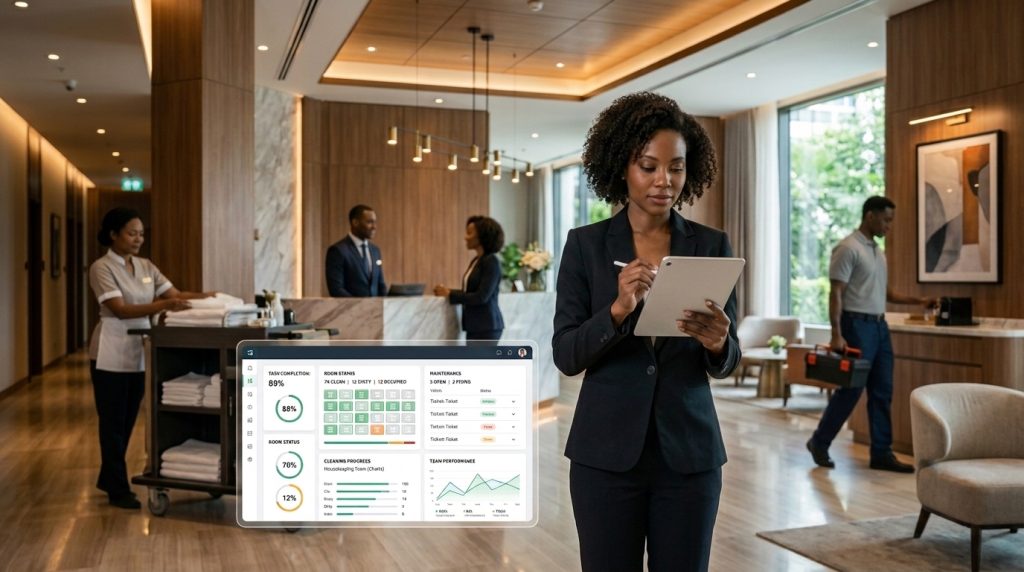
This is the gap hotel software like eZee is built to close. Its role-based user permissions mean every staff member logs in with their own credentials, so every check-in, rate override, or booking change is tied to a specific person, not a shared login. Its audit trail records the who, what, and when behind key actions across the front desk, housekeeping, and reservations, so a manager can review exactly what happened during a shift instead of piecing it together from memory. Its housekeeping module tracks room status changes in real time, so a missed or delayed clean shows up in the system immediately, not after a guest complaint. Picture the maintenance-room scenario from the start of this article, but with that kind of hotel software running in the background.
The moment the room was marked “under maintenance,” it would have been locked from check-in at the system level. If someone still checked a guest in, the record would show exactly who, and at what time, within seconds. What used to take an entire afternoon of guessing becomes a two-minute lookup. None of this is about watching staff more closely for its own sake. It’s about giving a hotel the kind of clarity that makes fair management possible.
With the right hotel software in place, accountability comes from visible facts, not guesswork — and staff are supported by systems that back them up instead of leaving them exposed. Because at the end of the day, technology and accountability aren’t about control. They’re about creating clarity for everyone involved, so both staff and management can do their jobs with confidence. Give your team the tools to succeed, not just the blame when things go wrong. Reach out today — Book a free demo with AOG to learn how eZee’s hotel software supports both staff and management.