
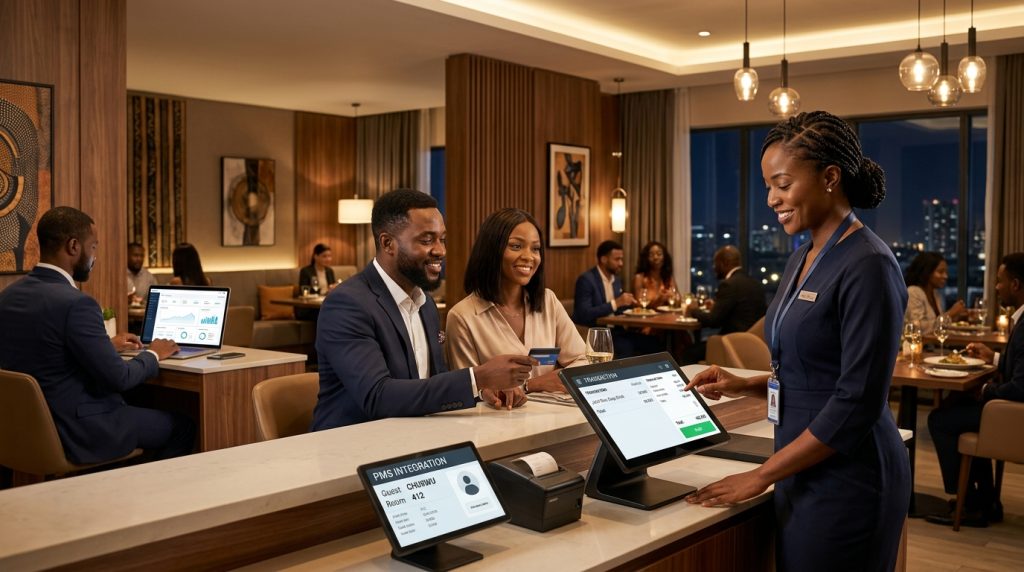
There’s a specific kind of exhaustion that comes from running a hotel restaurant where the POS can’t talk to anything else. A restaurant manager once summed hers up perfectly: by the time her shift ended, she wasn’t tired from the dinner rush; she was tired from re-typing every single bill into the front desk system by hand, hoping she hadn’t missed one. Some nights, a charge would slip through, a room folio would come up short, and nobody would notice until a guest questioned their bill at checkout, or worse, didn’t notice at all, which meant the hotel simply never got paid for it.
That’s not a staffing problem. That’s what happens when a POS is built to do one thing, like just ring up a sale and nothing more. A hotel restaurant manager in the country once described her old POS system as “a cash register with extra buttons.” It could ring up a bill, print a receipt, and not much else. Every charge from the restaurant had to be manually posted to the guest’s room folio at the front desk, by hand, at the end of a busy shift, and more than once, a charge simply got missed, quietly eating into revenue nobody ever traced back.
A hotel POS in 2026 isn’t supposed to work that way. The gap between a basic cash register and a genuinely modern hotel POS has widened, and the hotels choosing the right one are the ones protecting revenue that used to slip through the cracks.
1. Real-time PMS integration
The single most important feature a hotel POS can have in 2026 is a real, working connection to the property management system that works not as a once-a-day sync, but as real-time integration. A good PMS-POS integration validates guest details, posts charges directly to the correct room folio, and updates the PMS instantly as transactions happen, instead of relying on staff to manually transfer charges across systems.
Without this, every restaurant bill, spa charge, or minibar sale is a manual step where errors creep in: a charge posted to the wrong room, a transaction forgotten entirely, or a guest disputing a bill that was never recorded correctly in the first place. Industry trend reports point to this kind of unified data exchange as the defining shift in hospitality technology for 2026, as properties are moving away from systems that “talk” only loosely, toward PMS and POS sharing one guest profile and one real-time data stream.
2. Contactless and flexible payment support
Guests in 2026 expect to pay however is fastest and most convenient for them with just a tap of a card, a QR code, or a mobile wallet, without waiting at a terminal for a manual entry. A modern hotel POS needs to support contactless card payments, QR-based transactions, and mobile payment options as standard, not as an add-on. This kind of contactless and integrated payment support is now considered a baseline expectation for hotel POS systems, not a premium feature.
Flexible payment support also matters for something less obvious: guest trust. A slow or confusing payment process at the end of a meal or spa visit is often the last impression a guest takes away from an otherwise good stay — and it’s one of the easiest things to fix with the right POS.
3. Centralized inventory and sales analytics
A hotel isn’t just one point of sale; it’s often several, across a restaurant, a bar, room service, a spa, and sometimes a gift shop. A modern hotel POS needs to consolidate sales and inventory across every outlet into one view, rather than leaving each department to track its own numbers separately.
This matters for two reasons. First, it prevents the over-ordering, waste, and stockouts that come from tracking inventory manually or in isolation at each outlet. Second, it gives management actual visibility into which outlets are driving revenue and which items are underperforming insight that a fragmented, disconnected setup simply can’t provide.
For a hotel still relying on a standalone cash register, the difference isn’t cosmetic. It’s the difference between revenue that gets tracked properly and revenue that quietly slips through the same cracks it always has.
Choosing a hotel POS for 2026 and beyond
The hotel POS market has more options than ever, but the properties getting real value from theirs in 2026 are the ones prioritizing integration over gimmicks, a system that talks to the PMS, adapts to how guests actually want to pay, and gives management one honest view of performance across every outlet. Everything else is just extra buttons on a cash register.
2026 is separating hotels running connected systems from those still catching up. Talk to us about upgrading your hotel POS today; we are always available to assist you