
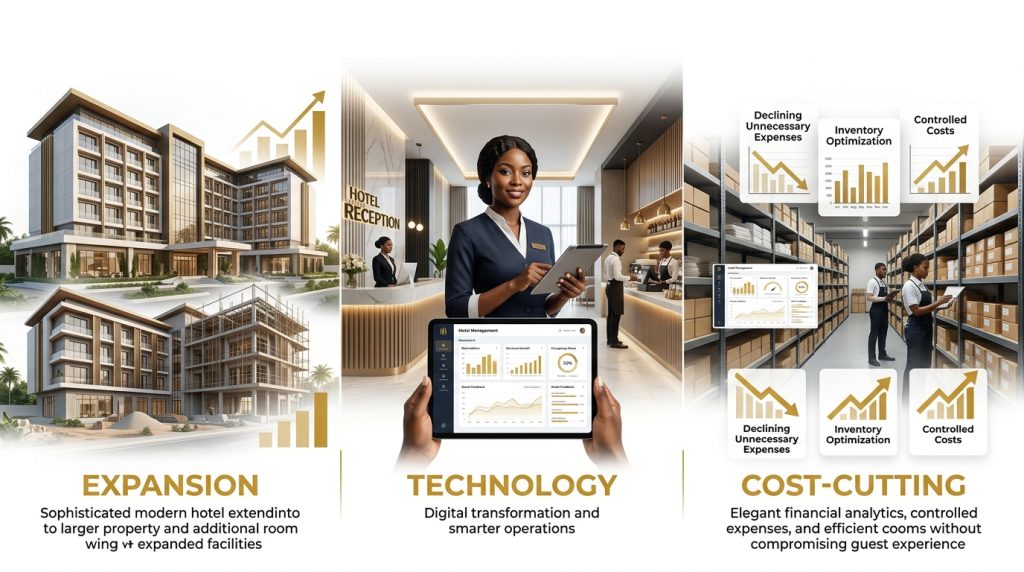
Growth priority isn’t a question most hotel owners sit down and answer deliberately. It usually just gets decided by whatever feels most urgent that quarter; for example, a competitor announced an expansion, so maybe it’s time to add rooms. A vendor pitched a shiny new system, so maybe it’s tech. Costs crept up again, so maybe it’s time to cut. Nobody’s wrong to feel pulled in all three directions. But with the rest of 2026 already narrowing, it’s worth actually picking one, on purpose, instead of drifting toward whichever pressure shows up loudest first.
So: (A) expand rooms, (B) upgrade tech, or (C) cut costs? Here’s what the data says about each path, and which one might actually be right for where your hotel stands right now.
Option A: Expand your rooms
Expansion is the most visible growth move, and it can be the right one, but 2026’s numbers suggest it’s not automatically the safest bet it used to be. Cost pressures have structurally increased operating expenses, particularly in labor and brand standards, even as revenue growth slows, meaning more rooms don’t necessarily translate into proportionally more profit the way they once did. Gross operating profit margins are declining across property types, driven by labour costs and escalating brand standards, a real headwind for anyone assuming expansion alone solves a growth problem.
That said, the investment appetite is still there. More than 90% of hotel investors plan to maintain or increase their allocations in 2026, with CBRE forecasting a 16% rise in investment volume. Expansion still makes sense but increasingly for owners who’ve already got their operational house in order, not as a first move to paper over deeper inefficiencies.
Option B: Upgrade your technology
This is where 2026’s data get genuinely compelling. Hotels using AI-enabled revenue management systems report an average revenue increase of 7.2% over traditional systems, according to Cornell’s Nolan School of Hotel Administration. That’s not a marginal gain; it’s a meaningful, measurable lift, achieved without adding a single new room.
The catch is execution. If labor models stay unchanged after new technology is introduced mobile check-in, keyless entry, AI messaging- the tech simply adds expense instead of freeing staff for higher-value work. Technology only pays off when it’s paired with an actual change in how the team operates, not bolted onto the same old workflow.
Timing matters too, more than most owners realize. A technology improvement made three months before a sale is a cost with no evidence behind it, the same improvement made eighteen months out becomes two years of trailing performance a buyer can underwrite and pay a premium for. Upgrading tech isn’t just an operational decision. For owners thinking about their asset’s future value, it’s a timing decision too.
Option C: Cut costs
Cost control sounds like the conservative, safe choice, and for hotels under real margin pressure, it might be. But the sharpest advice for 2026 isn’t “cut everything” — it’s “cut selectively.” Owners are advised to direct investment toward demonstrable revenue and profit opportunities, while simultaneously reducing costs that don’t deliver measurable guest satisfaction or operational efficiency. That’s a more surgical approach than a blanket budget freeze.
Realistic 2026 budgeting assumes modest ADR growth of 1–2%, flat occupancy, and RevPAR growth of just 0–1%, which means the days of coasting on rising demand to cover inefficient spending are largely over. Cost discipline matters this year in a way it hasn’t in a few years. But cutting the wrong things- guest-facing service, staff who directly drive satisfaction can cost more in lost bookings than it saves on paper.
So which one is actually your priority?
Here’s the honest answer: it’s rarely just one. Owners are being told plainly that profitability in 2026 depends less on market performance and more on managerial discipline, which means the real priority isn’t picking A, B, or C in isolation. It’s sequencing them correctly.
For most hotels, that sequence looks like this: fix the operational and technology foundation first, because that’s what makes cost control precise instead of blunt, and it’s what makes an eventual expansion actually profitable instead of just bigger. Cost-cutting without the right systems means cutting blind. Expansion without the right systems just multiplies whatever inefficiencies already exist. Technology, done right, is usually the lever that makes the other two options work properly when you do get to them.
Here’s how this plays out in practice
“Honestly, this is the moment eZee really shows its value; whatever path you go with, a connected system just makes life easier.” Real-time reporting shows precisely where costs are being wasted, so cost-cutting becomes targeted rather than a blunt, across-the-board freeze. Centralized data across every property and outlet means an eventual expansion inherits a proven, repeatable system instead of starting from scratch. And because the technology itself is measurable, occupancy, ADR, and channel performance are all visible in one place; it’s the kind of upgrade that shows real, trailing performance whenever you’re ready to make your next move, expansion included.
Here’s what it really comes down to
Growth priority isn’t really a multiple-choice question with one correct letter. It’s a sequencing question, and for most hotels heading into the back half of 2026, getting the foundation right is what makes whichever path you choose next actually work.
So, what’s the right sequence for you? Let’s figure it out together
If you’re still weighing expansion, tech, or cost control, let’s talk through where your hotel actually stands. Reach out, and we’ll help you figure out which move makes sense first and what should follow it.