
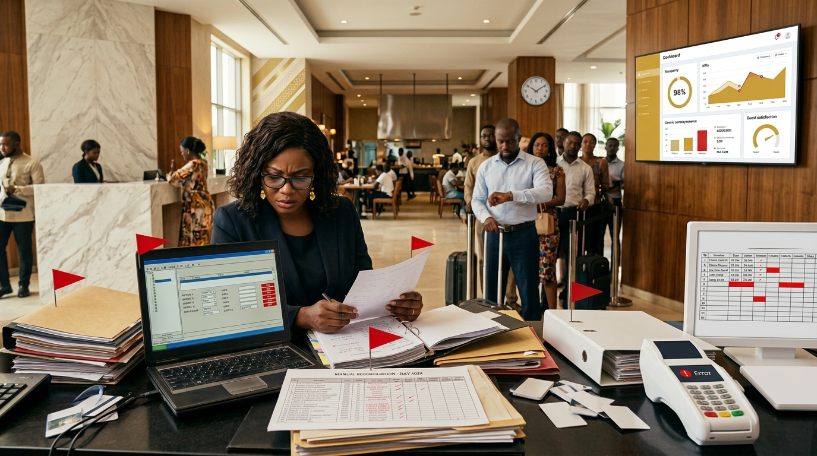
A PMS/POS upgrade is one of those decisions hotels tend to put off until something forces their hand: situations like a system crash during a fully booked weekend, a guest dispute over a charge nobody can trace, a staff member quietly reverting to a paper backup because the “official” system takes too long to load. Nobody wakes up one morning and decides today’s the day. It’s usually a slow build of small frustrations that finally tips into “we can’t keep doing this.”
If any of the five signs below sound a little too familiar, that tipping point might already be closer than you think.
Why a PMS/POS Upgrade Decision Carries More Weight Than It Looks
This isn’t a small software swap. Choosing a PMS today is a high-stakes decision that can lock a hotel’s tech stack in place for five to ten years, which is exactly why so many properties keep limping along on something that clearly isn’t working, rather than facing a decision that feels this permanent. But delaying doesn’t freeze the cost in place. An outdated PMS isn’t just a tool falling behind; it can quietly act as an anchor, limiting a hotel’s growth and generating silent losses every month it’s left unaddressed.
1. Your PMS and POS Barely Talk to Each Other
If a restaurant charge takes a manual step to reach the guest’s room folio, or your front desk team has to double-check numbers between two systems that were never really designed to sync, that’s the clearest red flag on this list. Historically, PMS managed rooms, and POS managed food and beverage; they talked, but only loosely, with data moving overnight and reporting lagging. That era is ending fast, and hotels still running on it are the ones absorbing the manual work and the errors that come with it.
2. Your System Is Physically Connected, Not Digitally Connected
If the only way to access your PMS is by sitting at the actual front desk terminal, your system is lagging well behind where the industry has moved. A PMS that’s only physically connected to the front desk rather than accessible through the cloud leaves a hotel unable to offer the mobile, real-time service guests now expect, and unable to let management check in on the property from anywhere but that one terminal.
3. New Staff Need Weeks to Learn the System, Not Hours
Hospitality has always had high turnover, but a genuinely modern system shouldn’t make that worse. When a system requires weeks of training because of a complex, unintuitive interface, the impact hits productivity directly and raises the risk of costly errors. Training new hires should take hours, not days, and definitely not weeks.
4. You’re Stuck Integrating One Connection at a Time
If every new OTA, payment provider, or third-party tool requires a custom, drawn-out integration project, your system’s underlying architecture is part of the problem. Two-way OTA sync, booking engine connectivity, POS integration, and payment gateway alignment are considered essential for operational stability in a modern system; if your current setup struggles with any of these, it’s a sign the foundation itself needs replacing, not just patching.
5. You’re Paying a High Upfront Cost Just to Keep It Running
Legacy, on-premise systems typically demand steep upfront investment in hardware and licenses, on top of an ongoing internal IT burden to manage manual updates. Subscription-based, cloud models with predictable monthly fees remove that heavy upfront cost, letting the technology pay for itself through the operation instead of draining it before a guest ever checks in. If your current system still requires a major capital outlay every time something needs upgrading, that cost structure alone is worth questioning.
What’s Actually Driving the PMS/POS Upgrade Shift Industry-Wide
2026 is being described as the year the line between PMS and POS finally blurs — the most competitive properties are treating these systems not as administrative tools, but as revenue engines and intelligence platforms in their own right. That’s a meaningful shift in how hotels are expected to operate, and it’s not one a fragmented, half-connected setup can keep pace with for much longer.
What a PMS/POS Upgrade Looks Like When It’s Fixed Properly
This is exactly the gap eZee Absolute and eZee Optimus are built to close. eZee Absolute and eZee Optimus share data in real time, so a restaurant charge posts straight to the correct guest folio without manual entry, new staff can learn the interface in hours rather than weeks, and management can check in on the property from any device, anywhere. Cloud-based pricing also removes the heavy upfront hardware cost that keeps so many hotels stuck with a legacy system they’ve long outgrown.
The Real Cost of Waiting on a PMS/POS Upgrade
None of these five red flags feel urgent on any single day. That’s exactly what makes them dangerous — the losses are quiet, spread out, and easy to write off as “just how things are” until they’ve added up to something significant. If two or more of these sound like your hotel right now, the upgrade isn’t really optional anymore. It’s overdue.
Are You Ready to Stop the Slow Leak?
If your current systems are showing these signs, let’s talk about what a proper PMS/POS upgrade could look like for your property. Contact us to schedule a demo presentation and see how eZee can bring your PMS and POS onto one connected, modern platform.