
Hotel staff accountability has a way of becoming a shrug. A general manager once told me about a missing minibar charge that took her three days to resolve, not because the amount mattered, but because nobody could say for certain which shift it occurred on, who last restocked the room, or whether the guest was even billed correctly to begin with. Three different staff members gave three different half-memories. In the end, she wrote it off, not because it was right, but because there was genuinely no way left to prove otherwise.
That’s the quiet cost of running a hotel on memory instead of records, and it’s exactly where hotel staff accountability starts to break down. Nobody’s necessarily lying. They’re just guessing, because guessing is all the system left them with.
Why Hotel Accountability Gaps Happen Even With Good Staff
It’s tempting to treat hotel staff accountability gaps as a people problem; for example, someone wasn’t careful enough, someone should have written it down. But the pattern shows up even in hotels with genuinely conscientious staff, which is the real clue that something structural is going on.
Shifts overlap. Verbal handovers lose detail in translation. A busy night means small tasks get done but never logged. None of this is negligence in the dramatic sense. It’s just what happens when a hotel’s only record-keeping system is a collection of human memories, each one fading a little more by the time anyone actually needs to check it.
What Changes When Your System Remembers Instead of Your Staff
-
- Handovers stop depending on who’s talking to whom: Digital tools like mobile check-in and app-based guest communication create structured digital records of requests and issues, which noticeably improves accountability and operational clarity across departments, such as a written, timestamped record that outlives any one person’s memory of a conversation.
-
- Room access stops being a shared secret: Some hotels are now integrating keyless access systems that let staff unlock only the specific room they’ve been assigned to service, replacing shared master keys with a full digital audit trail so “who was in that room” stops being a question anyone has to guess at.
-
- Financial records hold up under scrutiny. A reliable nightly audit trail keeps tax reporting, credit card compliance, and financial reviews accurate, giving leadership and auditors confidence that a property’s records genuinely reflect what happened rather than a stack of folios and a night auditor’s best recollection of a long shift.
-
- Oversight becomes a real discipline, not an afterthought: Hotel leaders are increasingly focused on tracking permissions, data access, and audit trails as more of their operations run through connected digital systems, treating accountability as core infrastructure rather than something to worry about only after a problem shows up.
How a Hotel Audit Trail Protects Staff, Not Just the Hotel
There’s an assumption that stronger hotel staff accountability means more suspicion of staff, but it usually works the other way. A team member who was wrongly blamed for a missing charge or a skipped task has no defense without a record. A team member who can point to a clear log of exactly what they did, and when, has real protection built into the system they use every day.
That shift changes the tone of performance conversations too, because hotel staff accountability becomes about facts, not opinions. Instead of a manager relying on hearsay or gut feeling, the data shows exactly where something went wrong and who might need support which turns a tense confrontation into a fixable, specific conversation.
What Hotel Staff Accountability Looks Like in a Modern PMS
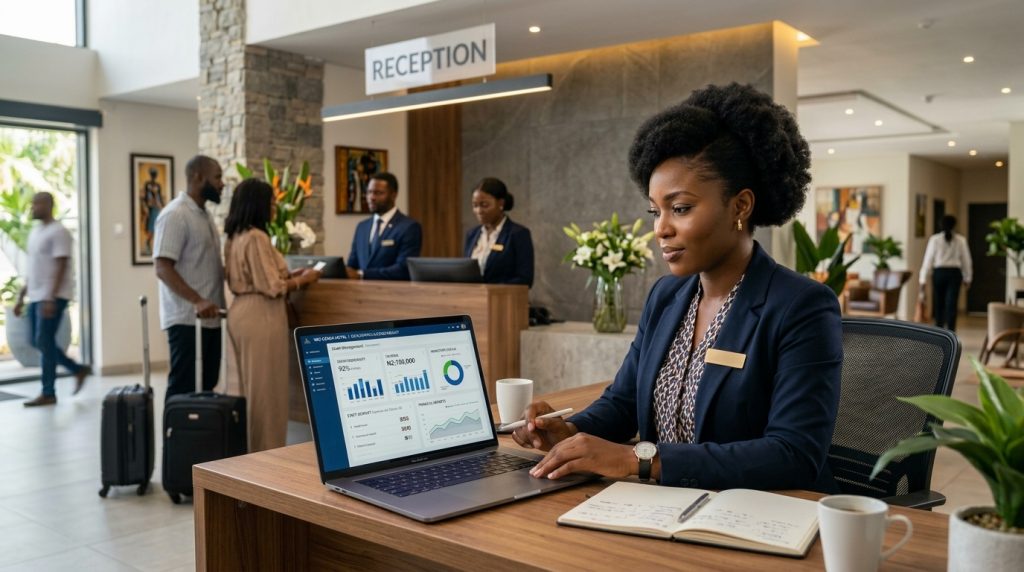
This is exactly the gap a good hotel PMS solution is built to close. Every staff member logs in with individual credentials, so a check-in, a rate override, or a room charge is tied to a specific person rather than a shared terminal. Its audit trail captures the who, what, and when behind key actions across the front desk, housekeeping, and reservations, so a three-day mystery like that missing minibar charge becomes a two-minute lookup instead. And because room status updates happen in real time, a missed task shows up immediately not three guests later, when it’s already become a pattern.
The Real Shift in Hotel Staff Accountability
Technology hasn’t made hotel staff accountability stricter. It’s made it provable. Instead of three people offering three different half-memories, a hotel with the right systems can simply check quickly, clearly, and without anyone needing to defend a guess.
That’s not a small change. It’s the difference between running a team on trust alone, and running a team on facts everyone can actually see when it matters. It also closes the small, untracked gaps that quietly drive hotel revenue leakage, the same gaps that separate efficient operations from profitable ones.
Let’s Close the Gap in Your Operations
If your hotel still depends on memory and shared logins to figure out what happened on a given shift, that’s worth fixing before the next disputed charge turns into a bigger headache. Drop a comment or send us a DM, and we’ll show you how to bring real, provable hotel staff accountability into your daily operations without adding extra work for your team.